
AI Video Tools You Should Know in 2026
AI has become a part of our everyday toolkit for many industries, including video production. From pre-production planning to post-production efficiencies and even content distribution, AI video tools are reshaping how media is created, scaled, and delivered.
That said, AI should enhance creative decision-making, not replace it. The most effective teams use AI to remove friction from workflows while keeping human storytelling, authorship, and craft firmly at the centre.
Here are six AI video tools every media professional should understand, and how they are practically being used today.
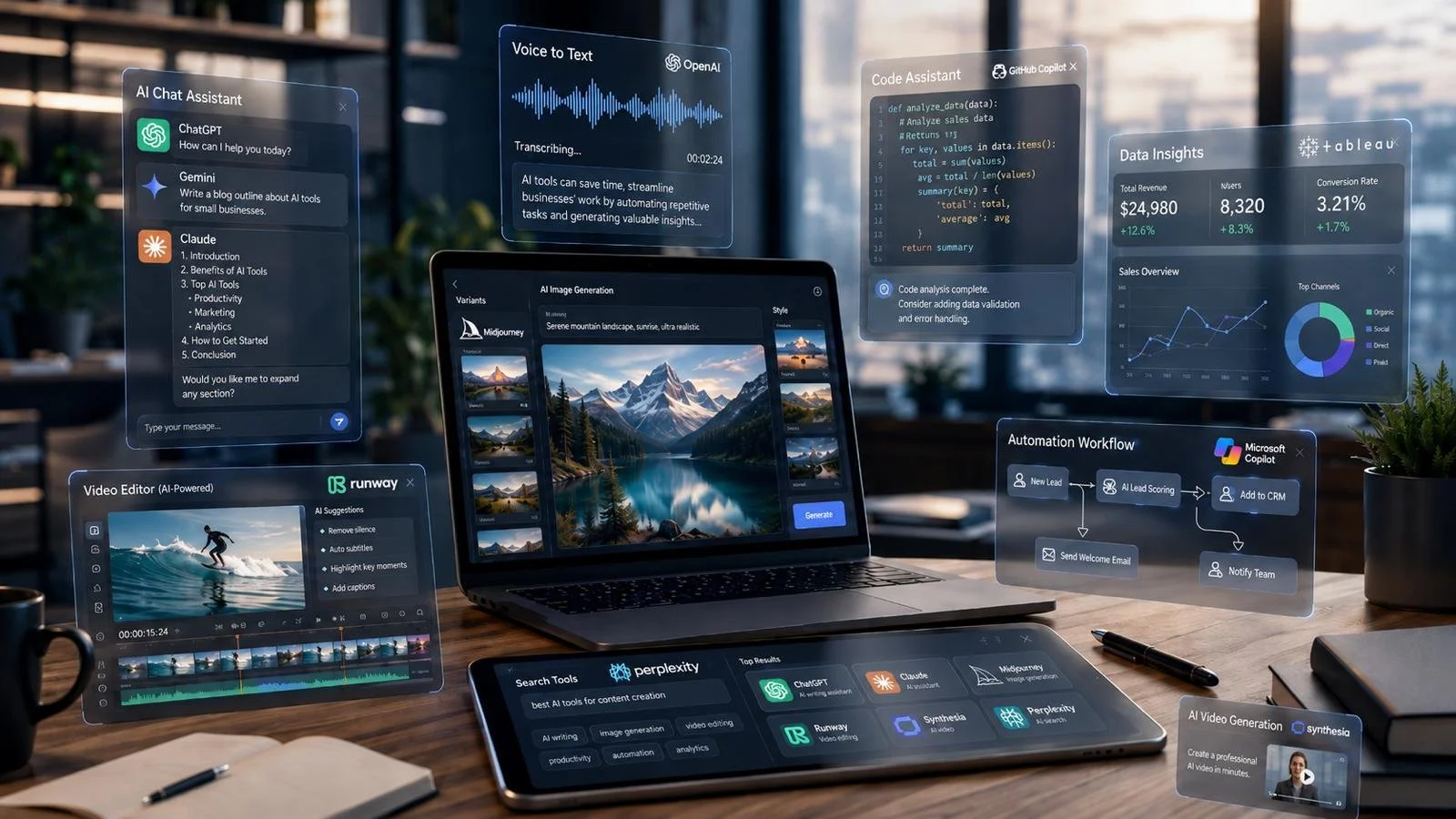
Some AI tools PPP works with
1. Sora
Best for: High-quality text-to-video generation and pre-visualisation
Sora has pushed the boundaries of what's possible with AI-generated video. Capable of creating realistic, cinematic sequences from simple text prompts, it allows creators to visualise concepts, environments, and storytelling ideas with unprecedented speed and fidelity.
For production teams, Sora is particularly valuable during creative development and pitching, helping clients and stakeholders see ideas before significant production budgets are committed. It can also be used to create animatics, mood films, and visual references that support the pre-production process.
While it is not a replacement for live-action production, Sora represents a significant step forward in AI-powered visual storytelling and offers a glimpse into how future creative workflows may evolve.
2. Midjourney
Best for: Visual ideation, mood boards, story development
Image generation platforms such as Midjourney have become increasingly useful during pre-production. Creative teams use them to develop mood boards, visual references, lighting concepts, location ideas, and production design inspiration. Instead of spending hours sourcing references online, teams can generate custom imagery that aligns closely with a project's creative direction.
These tools aren't necessarily replacing concept artists. When paired with human creative direction, they can dramatically accelerate the ideas and concepts without diluting originality.
3. Seedance
Best for: AI-generated cinematic video and rapid concept visualisation
Seedance is emerging as one of the most exciting tools in the text-to-video space. It allows users to generate surprisingly cinematic video sequences from simple prompts, making it a powerful resource during concept development and pitching.
For directors, producers, and creative agencies, Seedance can help visualise scenes before a camera is ever switched on. Story ideas, camera movements, environments, and visual styles can be explored rapidly, giving clients a clearer understanding of creative direction early in the process.
While AI-generated footage is still evolving, Seedance demonstrates how AI can support visual storytelling by helping teams prototype ideas faster and communicate concepts more effectively.
4. Nano Banana
Best for: AI image editing, asset generation, and creative experimentation
Nano Banana has gained attention for its ability to generate and manipulate images with impressive consistency and realism. For media professionals, this can be particularly useful when creating storyboards, concept frames, social media assets, or presentation visuals.
One of its strengths lies in helping creative teams iterate quickly. Need to explore multiple wardrobe options, environmental variations, or branding concepts? Nano Banana can generate alternatives within minutes, reducing the time spent on manual mock-ups.
For production companies, it offers a fast way to bridge the gap between an idea and a visual representation, helping stakeholders align before moving into production.
5. Adobe Firefly (Integrated Across Creative Cloud)
Best for: AI-enhanced design, video, and post-production workflows
Adobe’s Firefly is embedded directly into tools many production teams already use i.e. Premiere Pro, After Effects, Photoshop, and Illustrator.
From Generative Fill and Text-Based Editing to AI-powered colour matching and audio clean-up, Firefly improves speed and consistency across projects. Editors can now remove filler words, extend B-roll, or refine visuals using text prompts instead of manual timelines.
For agencies and production companies, Firefly fits seamlessly into existing workflows without forcing teams to relearn entirely new platforms. This is a major advantage when scaling output across multiple projects.
6. ElevenLabs
Best for: AI voiceovers, temp narration, multilingual content
ElevenLabs offers highly realistic AI voice generation, making it useful for temporary voiceovers, animatics, internal presentations, and localisation testing.
This is great for production teams working across multiple markets. Teams now have the ability to quickly test narration in different languages can save considerable time during development. It also provides a useful solution for creating placeholder narration before final voice talent is cast.
Human voice artists remain essential for emotionally driven storytelling, but ElevenLabs is becoming a valuable support tool in many workflows.
Final Thoughts: AI as a Creative Multiplier, Not a Shortcut
AI video tools are changing the economics and pace of video production, making high-quality output more accessible than ever. However, technology alone doesn't create meaningful stories. The teams that will benefit most from AI are those that understand where automation adds efficiency and where human creativity remains irreplaceable.
