
Watch how people around you use their phones on the MRT, in a Saigon café or on a date! They hold them upright. They scroll with one thumb. They rarely turn the phone sideways unless something has earned it.
Yet many brand films are still composed for a cinema screen, then cropped for social media at the end.
That order of operations made sense when television and YouTube were the main destinations. For most brands in Asia today, it is backwards.
The crop is where films lose their power
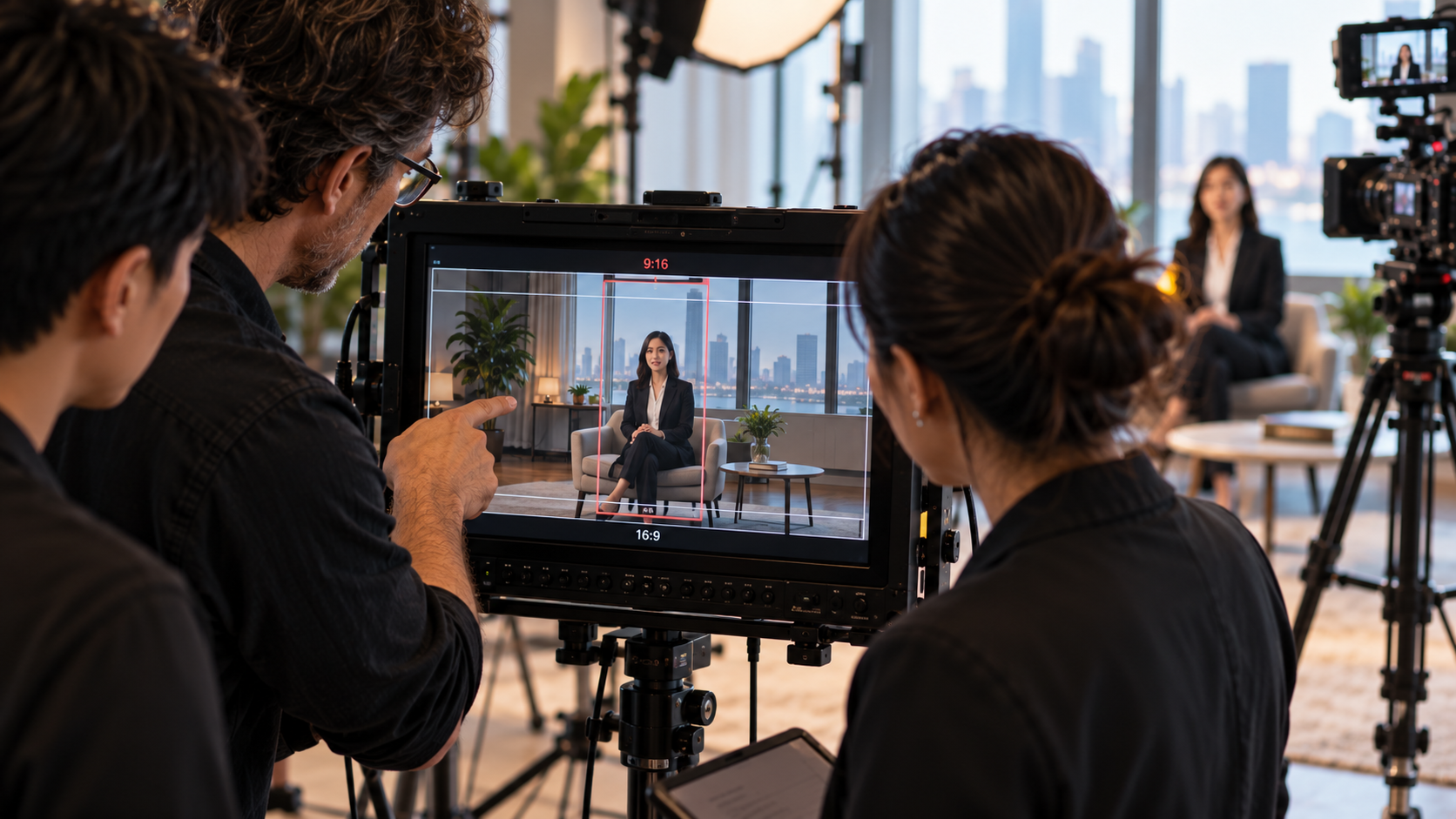
When a 16:9 film is cut down to 9:16, roughly two thirds of the frame disappears. Carefully composed shots lose their balance. Two people in conversation become one person and a shoulder. Text and logos fall off the edge. The editor spends days reframing, and the result still feels like a compromise.
Audiences notice. A film that was plainly designed for another screen feels slightly less intended for them.
Shooting vertical first flips this. You design for the screen most people will actually use, and treat the wide version as the adaptation.
How vertical-first changes the shoot
Composing for a tall frame changes more than the camera orientation.
Blocking. Vertical frames suit one person, or people arranged in depth rather than side by side. Movement towards and away from the camera works better than movement across it.
Close-ups. The phone screen is small and close to the face. Faces, hands and textures carry more weight than wide establishing shots.
Typography. On-screen text needs to sit in the safe zones that platform interfaces don't cover, which means planning for buttons, captions and profile names along the edges.
Pacing. Vertical viewers decide quickly whether to keep watching. The first two seconds need a reason to stay, which affects how scenes are written and ordered.
One shoot, three formats
The practical answer for most brands is not to choose one format. It is to plan for all of them from the start.
There are a few ways to do this:
• Shoot in high resolution and frame for the centre. Keep key action in a central zone that works for 9:16, 1:1 and 16:9. This needs discipline from the director and camera team on every setup.
• Dedicated vertical setups. For the shots that matter most, capture a separate vertical version rather than relying on a crop.
• A second camera rigged vertically. On interviews and key scenes, a second body in portrait orientation captures native vertical footage at the same time.
Each approach has costs, but all of them are cheaper than trying to rescue a horizontal film in the edi
Getting the edit right
Shooting vertical-first is only half the job. The edit has to follow through.
Vertical edits generally move faster than horizontal ones. Scenes are shorter, and the opening needs to establish the story almost immediately. A slow, atmospheric opening that works beautifully on a large screen can lose a mobile viewer in seconds.
Sound matters, but so does silence. Many people watch social video with the sound off, at least at first. Captions should be designed in rather than added as an afterthought, styled to match the brand and placed where platform buttons won't cover them.
It also pays to cut separate versions for separate platforms rather than one vertical edit for everything. The ideal length, pacing and opening for a LinkedIn audience often differ from those for TikTok or Instagram.
The good news is that if the shoot was planned properly, these versions come together quickly. The hard work happened on set.
When horizontal still earns its place
None of this means 16:9 is finished.
Horizontal still matters for event screens, broadcast, cinema, YouTube, presentations in the boardroom, and websites viewed on a desktop. A corporate film shown at an annual conference needs to fill a wide screen.
The point is to decide where your film will actually be watched, and design for that first. For many campaigns the answer is the phone. For some it is the ballroom. Most need both.
A note on budget
Planning for several formats doesn't have to double the cost. Most of the expense in a shoot is fixed: crew, location, talent, the day itself. Adding vertical setups or a second camera adds hours, not days. The bigger cost is usually in the edit, and a well-planned shoot makes that edit faster, because the footage was captured for each format rather than rescued from one.
Questions to ask before your next shoot
• Where will most people see this film?
• Which format is the hero, and which are adaptations?
• Which shots need a dedicated vertical setup?
• Is the on-screen text designed for every format's safe zones?
Settle those in pre-production and you'll end up with films that feel native everywhere they appear.
Planning a campaign shoot? Ask us for a vertical-first shoot plan, and we'll show you how to cover every format without doubling the budget.
